
Have you noticed your social feed suddenly looks like a bizarre sci-fi art gallery? The internet is absolutely flooded with artificially generated promos. From local gym ads to weekend music festivals, everyone's suddenly a "designer." But this explosion of AI flyer design isn't just creating a sea of weird, glossy stock photos, it's quietly sabotaging the brands using it.
While it feels like a magic bullet for your generative AI marketing, these synthetic graphics are packed with subtle mistakes that kill consumer trust. If your audience spots the flaws before they read your offer, they're gone. In this guide, we'll cover exactly how to identify AI-generated marketing, the seven dead giveaways of machine-made graphics, and why these shortcuts actually destroy your sales.
What Is AI Flyer Design?
AI flyer design is the practice of using artificial intelligence image generators to output promotional materials based entirely on text prompts, and then publishing that raw output directly as final commercial art. There's a massive difference between using AI as a moodboard tool for inspiration and letting an algorithm drive your entire creative process without human oversight.
Why Is AI Flyer Design Suddenly Everywhere?
Honestly, the barrier to entry dropped to zero overnight. It used to take a skilled designer and a firm Friday deadline; now, it just takes a prompt and a bored Tuesday afternoon.
Naturally, we're seeing a cross-industry avalanche. Real estate agents, local bars, and life coaches are all churning out promos at lightning speed. Given that AI usage in content creation jumped over 200% recently, it makes sense why everything suddenly looks the same. The sheer volume of AI flyer design is causing massive consumer fatigue, making it harder than ever for genuine brands to stand out.
The 7 Telltale Signs of an AI-Generated Flyer
When you spot an AI flyer design in the wild, the flaws are impossible to unsee. Here's what gives them away.
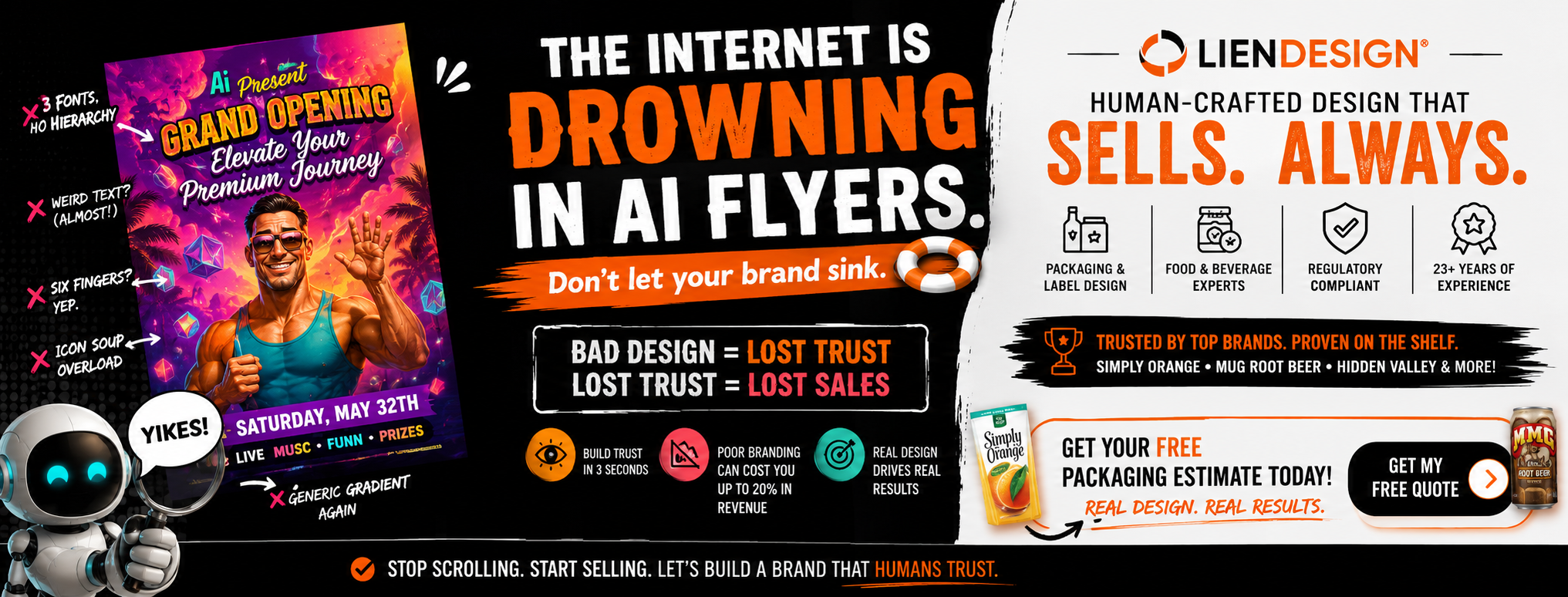
1) Three Fonts Fighting Each Other
AI simply doesn't understand visual hierarchy. It's not a structured message; it's a shouting match where a bold serif, a modern sans-serif, and a chaotic script all fight for your attention at the exact same time.
2) Text that’s Almost Right
Algorithms don't read; they just draw shapes that look like letters. This leads to classic AI image generator text errors. You'll spot the classic lowercase "Ai" typo, or words that almost spell "Grand Opening" but end up reading like alien gibberish.
3) Generic Gradient Backgrounds
Algorithms love to play it safe. Because they average out millions of reference images, every single flyer seems to have the exact same neon-sunset glow, somehow.
4) Icon Soup
Machine learning models are terrified of empty space. Instead of embracing clean minimalism, they cram in random sparkles and floating geometric shapes as if they're trying to meet a quota.
5) A Tagline that Doesn’t Belong to Anyone
Generators string together confident-sounding, empty corporate buzzwords that have zero actual meaning. It's how you end up with "Elevate Your Premium Journey" for a neighborhood bake sale.
6) Stock People Who Feel Slightly off
The uncanny valley hits hard here. These artificial people have a slightly glazed "almost-smile", and let's not even get started on the six-fingered hands.
7) Zero Brand Consistency
Let's get serious for a second. This is one of the biggest AI design fails, and it's the one that drains your wallet. AI doesn't know your brand guidelines or color palettes. Your brand consistency vanishes, making every promo look like it belongs to a totally different company.
Why This Actually Costs You Sales (Not Just Looks)
It's funny until it's your product launch. In consumer psychology, trust signals are established in a split second, during a 3-second judgment. When people notice uncanny visuals, their brains instinctively flag the material as low-effort or even a scam.
Studies show poor, inconsistent branding can drop revenue by up to 20%. Why AI design hurts sales is simple: if your marketing looks rushed and fake, potential buyers unconsciously assume your product is, too.
Best Label Design Agency in San Diego
When you move from disposable social posts to tangible, real-world products, the stakes skyrocket. That's why working with the best label design agency in San Diego has to offer is so crucial.
A real label design agency brings deep production knowledge, print specifications, regulatory copy expertise, and strict brand consistency, things a prompt simply can't handle. Backed by over 23 years of San Diego-based experience, we've built trust for named clients by treating design as a highly specialized craft.
What This Means for Packaging and Label Design Specifically
A digital flyer gets scrolled past in two seconds, but physical packaging sits on a retail shelf for 30 days. In print, mistakes are permanent.
Take the Huggies package redesign, for instance. By targeting upper-income households with strategic, human-led design decisions, they saw a 5% sales bump and hit an all-time quarterly record of $3.9 billion. That's real-world shelf appeal that algorithms simply cannot replicate.
Packaging Design Agency for Food and Beverage Brands

As a dedicated packaging design agency for food and beverage brands, we know firsthand how brutal the retail shelf is. Food, beverage, supplement, and beauty clients face strict FDA rules, mandatory allergen labeling, and the absolute need for shelf legibility at tiny sizes.
AI can not give you this precision or FDA-compliance yet. That’s why it’s important to contact a design studio like Lien Design that can take your AI product images, and make them into a real life, printable and human-feeling package design.
Proper packaging design for food and beverage brands requires precision. We've proven this with clients like Simply Orange, Mug Root Beer, Smart Syrup, and Hidden Valley. They rely on human vs AI design because their labels must be flawless, compliant, and undeniably appetizing.
How to Tell If Your Own Materials Have This Problem
Do this quick test, it only stings a little. Pull up your last three marketing graphics. Are those actually your brand fonts? Are there weird typos hiding in the background? Does the imagery look like a generic internet fever dream?
Pro tip: If your logo warps or your colors shift drastically from post to post, you've got a synthetic design problem.
Curious if your brand needs a refresh? Evaluate your brand packaging by requesting a quick, professional review.
AI as a Tool vs. AI as the Designer
We aren't saying artificial intelligence is useless. It's actually a fantastic tool for generating initial moodboards or speeding up background photo edits. But it can't replace the strategic judgment required to build a real brand. Basically, AI is a great intern but a bad creative director.
Final Words
Next time you spot a neon-soaked promo featuring a six-fingered bodybuilder, you'll know exactly what happened. Sacrificing your credibility for convenience is never worth the shortcut. Relying on automated AI flyer design might save a few hours today, but it ultimately costs you consumer trust and long-term sales.
Ready to build a brand that actually connects with humans? When you need strategic, human-crafted package design, Lien Design is here to help.
Get a free packaging estimate from a real designer, and let's get to work.
Why Should You Choose the Experts at Lien Design?
Tom H. Lien is an award-winning art director, best-selling author, and the founder of Lien Design. With over two decades of experience, Tom leads a boutique San Diego studio dedicated to creating designs that captivate consumers and sell effectively. He blends artistic storytelling with shelf-presence science to ensure your packaging serves as your brand's most powerful salesperson.
We can help you take that weak, and obvious brand design, and create something human, with feeling, that actually prints and reproduces correctly.
FAQs About AI Brand Design
Is it bad to use AI tools anywhere in the design process?
No, AI is great for brainstorming and moodboards. The risk lies in using unedited raw outputs as final art, which can lead to brand inconsistency and visual errors.
How can I tell if my own marketing materials have this problem?
Check for shifting brand colors, melted typography, and visual glitches like extra fingers. If your platforms lack a unified look, you might be over-relying on automation. Spot AI packaging design mistakes before going to print to save your budget.
Why does AI struggle so much with text on flyers and labels?
Image generators don't read or understand typography. They predict pixel patterns, trying to draw the "shape" of text rather than writing words, resulting in gibberish.
Does this affect printed packaging the same way it affects social flyers?
Yes, but it's much worse. Social posts fade away, but print runs are expensive. AI can't handle bleed lines, CMYK color, or FDA-compliant copy.
Can a designer fix an AI-generated flyer, or do you have to start over?
Lien Design can definitely take your AI image or AI product and recreate it to feel human, and print properly. Usually, you have to start over. AI gives you flattened, low-res images, not editable vector files. Rebuilding from scratch ensures proper print specs and brand consistency.